

Gaa is thrilled to present A Room That Once Was, an exhibition bringing together works by Julia García, Melissa Joseph, Anina Major, LaRissa Rogers, Curtis Talwst Santiago, Johanna Seidel, Jia Sung, and Malaika Temba. Across painting, textile, ceramics, sculpture, video, and installation, the exhibition considers how domestic objects, intimate surfaces, and inherited forms become carriers of displaced memory. Rather than a fixed refuge, home is treated as a mutable site, where gender, labor, kinship, and migration are continually negotiated.
Throughout the exhibition, domestic space emerges as a structure shaped by repetition, care, and emotional residue and less as a stable interior. In Malaika Temba’s Preparing Dinner, labor and ritual gather around the scene of sustenance, while Melissa Joseph’s Reading by Danielle turns an intimate act of Tarot reading into a meditation on memory, family history, and the politics of how space is occupied. Temba’s broader practice extends this domestic register into a wider reflection on women’s labor, diaspora, and intergenerational care, using jacquard weaving, paint, and embroidery to transform textile into a record of resilience as much as softness. Joseph’s practice, shaped by questions of belonging, cultural inheritance, and diasporic identity, lends particular weight to the exhibition’s understanding of the interior as both lived environment and social construction—a space where family narratives are preserved, negotiated, and revised.
Rogers and Seidel extend this inquiry into threshold states—doors, passages, and points of entry where intimacy meets fracture. Rogers’ A stratigraphic threshold of broken inheritance binds welcome, fragility, and ancestry into a single sculptural proposition, while Johanna Seidel’sGhost World, Before you knew yourself, and The door we never opened imagine the interior as a site of hesitation, projection, and unresolved psychic charge. Seidel’s paintings deploy a poetic visual language in which symbols drawn from dreams, history, mythology, and everyday life stage scenes that feel at once personal and mythic; her muted, earthy palette gives these images the quality of something unearthed, as if each room or figure were quietly returning to its material origin.
Movement, rupture, and the afterlife of material remain central to the exhibition’s understanding of home as something carried across distance rather than permanently secured. Anina Major’s These Boots Were Made For Walking traces fractured cultural connections across the Black diaspora through body movement as an expression of agency and a way of thinking through inherited history. Walking and prancing across crushed conch and oyster shells, ceramic mammies shards, and fragments of woven work, Major embraces ruin as a sign of temporal in-betweenness, transforming debris into an unconventional land-based monument that holds destruction and perseverance in delicate tension.
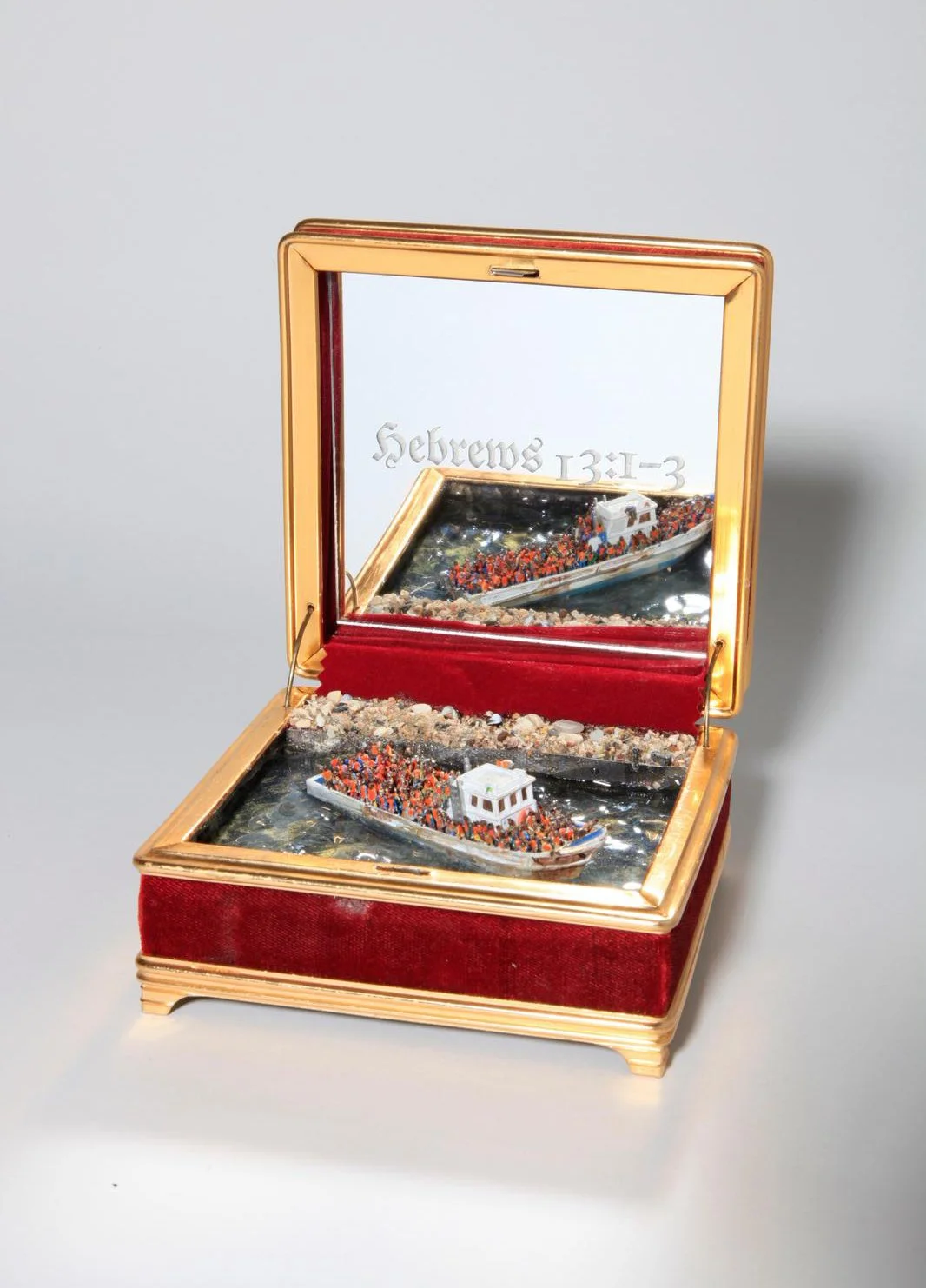
Curtis Talwst Santiago’s Deluge Xl extends these concerns into the terrain of migration, colonial violence, and witness. Part of his ongoing Infinity series of miniature dioramas staged inside reclaimed jewelry boxes, the work uses the box as both container and stage: a vessel for preserving what is precious, but also for revealing stories that history has minimized or suppressed. Drawing on storytelling traditions in African and Caribbean cultures as forms of resistance, the series invokes migrant journeys across the sea, the legacies of the transatlantic slave trade, and the desperation of forced movement; in Deluge Xl, however, the sea appears calmer, the boat nearer to shore, and the mirrored inscription of Hebrews 13:1–3 introduces an ethics of brotherly love, hospitality, and solidarity with the suffering stranger. Read alongside Major and Rogers, Santiago’s work insists that domesticity cannot be separated from the historical conditions that have repeatedly made and unmade the possibility of shelter.
Materiality becomes one of the exhibition’s most connective languages, linking clay, ceramics, textile, and domestic objects as carriers of memory, labor, and transformation. Melissa Joseph’s combination of stoneware and felt, Malaika Temba’s jacquard-woven surface, and Jia Sung’s wool and cotton tapestry locate memory in fabric and surface, while Anina Major and LaRissa Rogers extend that conversation through ceramic form. Major works with clay in a manner that recalls basket weaving, translating plaited structure into a sculptural language shaped by Bahamian straw-work and vernacular traditions, while Rogers casts domestic forms such as pans and irons in slip, recasting household tools as fragile vessels of ancestry, labor, and cultural memory. Together, these works understand the domestic as a material system—something made, handled, and occasionally destabilized—through which stories of kinship, migration, gender, and survival are transmitted and transformed.
Julia García’s works on paper of interior scenes and The Mower extend these concerns into the realm of atmosphere and representation. Working from found source imagery, often discarded photo albums of strangers, García draws on images that feel at once intimate and estranged, probing nostalgia, idealism, and the systems of value embedded in the domestic image. Her rooms and scenes seem suspended, as though familiarity were steadily giving way to unease. In this context, her paintings resonate with Seidel’s haunted interiors and with Joseph’s and Temba’s attention to the social choreography of everyday space, offering an image of home as both stage and afterimage.
Collectively, the works in A Room That Once Was propose domestic space as an unstable authorship: a place assembled from ritual, image, inheritance, repair, and fracture. What these artists share is not a single image of home, but an insistence that it is continually made and remade through bodies, objects, and memories that exceed the boundaries of any one room. In this exhibition, the domestic is both container and actor—holding the weight of history while remaining open to reinvention.