

SOFT STORAGE
TRAVIS BOYER, MONIKA GRABUSCHNIGG, BRIDGET MULLEN, LARISSA ROGERS, KERTTU SAALI, JIA SUNG
APRIL 28 – JUNE 20, 2026
COLOGNE
OVERVIEW
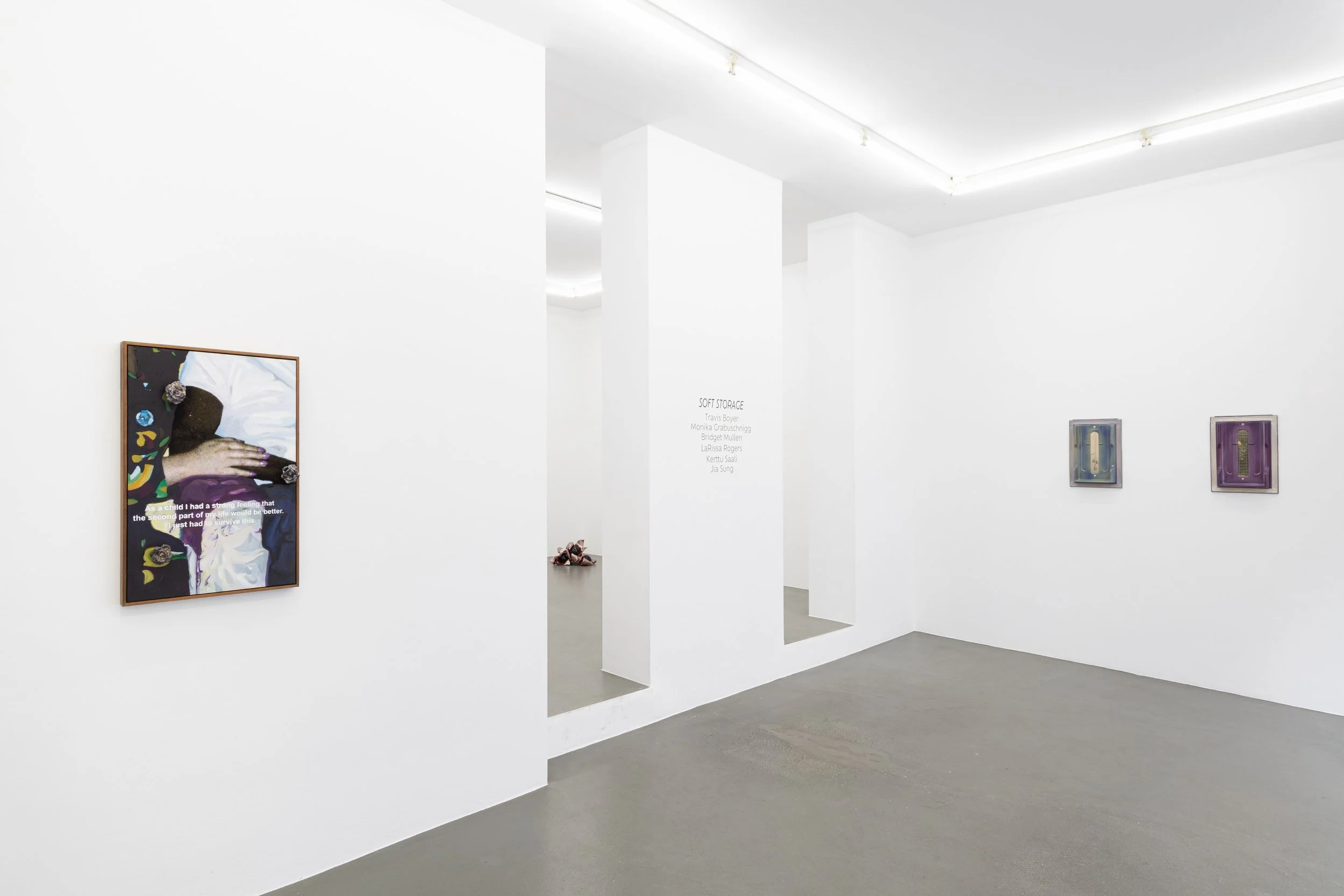
Gaa is delighted to present Soft Storage, a group exhibition featuring Jia Sung, Travis Boyer, Monika Grabuschnigg, LaRissa Rogers, Bridget Mullen, and Kerttu Saali.
In Soft Storage, the body is not treated as a fixed container but as a shifting archive that absorbs, alters, and releases memory through its surfaces and folds. The artists approach embodiment as a form of storage grounded in material: fabric, clay, pigment, and glaze carry traces of lived and inherited experience. These works hold what resists documentation — impressions, distortions, fragments, and residues that persist in physical form. What remains in the body is the quiet pressure of sensation against forgetting.
This idea of storage is about metabolism, where surfaces seem to receive and retain touch, absorbing the pressure of fingertips, the memory of movement, and the residue of repeated contact. What emerges are impressions that linger, emotions settling into objects, forms that recall handling, and images suspended between embodiment and release. Material behaves like memory: it softens, hardens, accumulates, and slips.
In Travis Boyer’s velvet paintings, surface behaves like a receptive skin. Dye seeps into silk velvet unevenly, producing forms that hover between image and afterimage, as though memory were being registered not as document but as sensation. Candles, cuts of meat, and dancing figures appear softened at the edges, held in a suspended state where touch, duration, and recall seem to merge.
Another kind of openness can be found in Kerttu Saali’s paintings. She allows color, light, and form to guide the image toward something intuitive and slightly beyond language. Her paintings suggest that memory can also be atmospheric: a fleeting condition, a quiet pressure, or a visual thought not yet fully formed. The carved wooden frames, which extend the paintings outward rather than contain them, reinforce this sense that the image cannot be fully enclosed.
For Monika Grabuschnigg, domestic objects and organic forms become psychological vessels, absorbing and preserving intimacy, longing, and loss. Her ceramic works in the exhibition draw on structures associated with cooling, covering, and preservation, transforming these utilitarian forms into emotional archives. The tension between containment and vulnerability runs throughout her practice: her sculptures appear heavy and bodily, yet also tender, as though caught between blooming and fading.
Bringing myth, folklore, and iconography into the exhibition, Jia Sung considers the body as a site of projection and inheritance. Working across painting, textiles, printmaking, and writing, she draws on Chinese mythology and Buddhist imagery to reconsider archetypes of femininity, queerness, and otherness. Her works suggest that memory is not only personal but cultural — carried through stories, symbols, and visual languages that are repeated and revised over time.
Similarly, LaRissa Rogers approaches memory through history, cultural identity, and the question of what survives. Her multidisciplinary works often begin with research and material inquiry, using personal and collective traces to think through placemaking, inheritance, and the afterlives of lived experience. In the works shown here, image and object operate together as carriers of testimony, where intimate fragments become inseparable from broader social and political histories.
Bridget Mullen’s paintings move through layered marks, flickers of pigment, and forms that emerge gradually between abstraction and figuration. Eyes, limbs, and gestures surface as if remembered rather than fully seen, giving her paintings a bodily presence that feels unstable, searching, and alive. In relation to ideas about the body, her work suggests that the body is not a singular image but a field of accumulated marks: something built through repetition, hesitation, and continual transformation.
Throughout Soft Storage, bodies appear not as stable wholes but as permeable sites shaped by contact with the world around them. Memory is carried in materials that absorb, harden, stain, stretch, and preserve; in forms that fold, spill, hover, and return; and in images that remain slightly unresolved, as if still in the process of becoming. The title names this condition of holding softly: a mode of preservation that is neither fixed nor complete, but lived through residue, sensation, and the persistent pressure of what stays with us.