

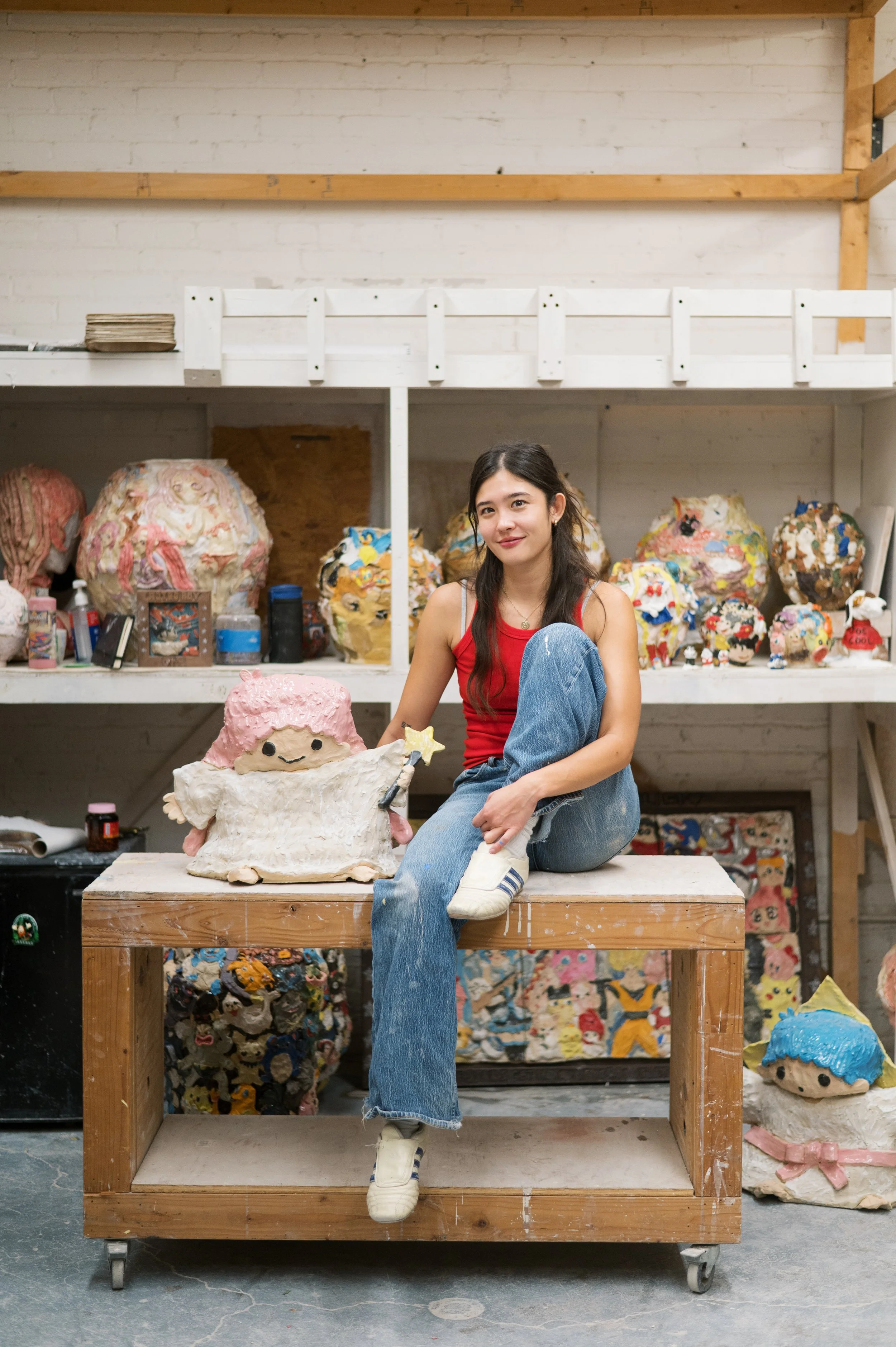
Gaa is pleased to present Hunky Dory, an exhibition of ceramic works by Chicago-based artist Emily Yong Beck. In her fourth solo exhibition with the gallery, Beck continues to examine the cultural, geopolitical, and personal histories embedded in cartoon imagery and commercial icons, from Disney animation to Japanese anime. Drawing on kawaii culture, the global circulation of Japanese popular media, and her lived experience as a Korean American, she considers the double-edged power of cuteness: its capacity to generate affection and cross cultural boundaries while obscuring histories of imperialism, violence, appropriation, and erasure.
Beck is particularly interested in the global embrace of Japanese popular culture in the decades following World War II, and the relationship between cultural fascination and historical forgetting. Through mass production and commercialization, characters become detached from their original narratives and cultural contexts, transformed into universally recognizable commodities. This circulation produces a complex contradiction in which Japanese cultural imagery is widely celebrated and consumed, while the histories of Japanese imperialism, particularly in Korea, recede from view. Cuteness thus operates not merely as an aesthetic language, but as a vehicle of cultural soft power through which historical and political tensions can be rendered invisible.
For Beck, these questions are inseparable from her own history. Born in Korea to a Korean mother and an American father who served in the U.S. military, she describes her own existence as a consequence of Japanese and American imperialism. Growing up in the United States, her early encounters with Asian cultural representation came largely through Japanese popular imagery, including Hello Kitty and other familiar characters. These figures provided comfort while complicating her understanding of cultural identity, as distinctions between Korean and Japanese cultures were frequently blurred. Her work holds that childhood attachment alongside an awareness of the histories and power structures embedded in the images she loves.
Several works in Hunky Dory depart from Beck’s familiar moon jar–inspired vessels, extending these concerns into new sculptural and material forms. In Stars Wall (2025), six ceramic panels form a dense, tactile bas-relief within a hand-carved wooden frame. Characters including Goku, Astro Boy, Doraemon, Pikachu, Kirby, Sailor Moon, Godzilla, and Anpanman crowd its surface, their limbs and weapons tangling in a confectionery mass of glossy, candy-colored clay. The composition evokes histories of conflict and violence in Korea, transforming familiar icons into a compressed scene of entanglement and confrontation. Crushed abalone shell forms stars along the sides of the frame, recalling traditional Korean decorative arts and mother-of-pearl inlay. Across the top, an inscription in Hangul reads, “These are my friends and I love them.” On the reverse, concealed from view, Beck has drawn the same cartoon characters locked in battle amid explosions and scenes of destruction, drawing on Henry Darger’s fantastical, apocalyptic imagery. The affectionate inscription and hidden battle scene give the work two registers: an expression of attachment on one side and a scene of violence on the other. Neither cancels the other out
In Hatsune Miku Live (2026), Beck incorporates a holographic projection of Hatsune Miku, the Vocaloid virtual pop star, into a miniature ceramic structure resembling a shrine or grotto. Carved cartoon figures surround the performer, while a peace sign crowns the structure and golden, Darger-inspired explosions punctuate its surface. The work brings the handmade irregularity of clay into contact with the spectacle of digital culture, giving a performer without a physical body an intimate architectural setting. The shrine becomes a site of devotion to an artificial icon, raising questions about how digitally generated figures become the focus of genuine attachment.
Aekddaem Trinket Shelf (2026) offers a more intimate perspective through the Korean concept of aekddaem, the belief that small misfortunes can ward off something worse. Comprising thirty-three ceramic trinkets, the work transforms emblems of minor misfortune into objects of protection and affection. Alongside the exhibition’s darker historical undercurrents, the shelf introduces a quietly hopeful possibility: that a small setback might itself offer a form of protection.
Beck’s approach to making is equally deliberate. Describing her practice as “sloppy craft,” she embraces irregularity, experimentation, and play. Her handmade interpretations of familiar icons disrupt the polished uniformity of mass-produced characters, giving widely circulated images a particular material presence. For Beck, this approach also challenges expectations of mastery, discipline, and physical endurance that she associates with male-dominated traditions of Korean ceramics. Rather than treating technical control as the sole measure of accomplishment, she makes room for pleasure and imperfection.
The title Hunky Dory invokes the familiar assurance that everything is just fine. Here, that reassurance remains unsettled, but so does the possibility of dismissing the characters as merely deceptive or compromised. Beck neither relinquishes her affection for these figures nor separates it from the histories she examines. “These are my friends and I love them” becomes both a declaration of attachment and an acknowledgment of how difficult that attachment is to resolve.